19.8.10

Wind Tree wins Merit at Lite-On Award, Taiwan

Paul & Suhasini were honored with the Merit Award for their concept : Wind Tree - an alternate micro-electricity generator to feed the electrical vampires and thus save electrical loss which amounts to about 25% of our electricity bill.
The number of contestants and entries hit yet another record high, attracting nearly 6,000 emerging and professional designers from Europe, Asia and the United States, with a total of 2,538 entries competing for a total of one million in award prizes. In response to climate change and global trends in environmental change, the theme for this year's Lite-On Award was "Green Evolution: Sailing to the Green Ocean" hoping to inspire designers to merge technology and green design ideas in the creation of a mighty and eco-friendly Green Ocean. Lite-On Award is touted as the Chinese Academy Award for Industrial Design. The awarding ceremony of the 2010 Lite-On Award was held in Taipei.

7.2.10

1.1.10

Yellow Ink!

Invite you to view more of my illustrations here : Yellow Ink! of my Inflatable Pen.

30.12.09

Blindfold* wins OPUS Design Award'09 | Japan


Dare to bare out-of-doors?
See-through blindfold is inspired from the silk/satin love laces which have ruled the boudoir while you try blindfolding your partner to heighten the pleasures of imagination through adult fantasy play.
This time: Peeking is allowed!
I propose a fashion glare which tries to capture the sensuousness of satin folds - the smooth silky flow and the deceptive transparency of lace. It gives a feeling to the onlooker that you are blindfolded and titillates his senses, running him wild.
--------------------------------------------------------------------------
Best features:
1) Lusty - bring the excitement out-of-doors!
2) Stylish – flaunt your oomph factor!
3) Deceptive –feels like the beholder is blindfolded!

--------------------------------------------------------------------------

Blindfold is proposed to be made in photochromic polycarbonate.
A floral print is embedded into the surface layer of the material in a uniform thickness of up to 150 µm. Upon exposure to UV radiation in day light floral patterns become visible, otherwise invisible.

The floral pattern darkens substantially in response to UV light in less than one minute, and then continues to darken very slightly over the next fifteen minutes. It fades back to clear once moved indoors. It is tinted with exotic colors in the bleached state.

Blindfold* is an unique toy for adult fantasy play suited for romance out-of-doors!


15.12.09

9th CII - NID Design Summit, Delhi

Paul Sandip: invited as speaker at 9th CII - NID Design Summit, Delhi to discuss about the key enablers which will make India - the emerging powerhouse of design.

5.12.09

International Volunteers Day!


Voluntary contribution towards posters for Swechha - We for Change, a Delhi based NGO.

22.8.09

Disposable Mug | Finalist at INDEX: Award 2009


The finalists for INDEX:Award 2009 have been selected by the international INDEX: jury as the best of the best from the a total record-setting number of nominations from 54 countries.

The finalists, taken as a group, offer unique proof of the wide reach of Design to Improve Life, in terms of geography, challenges addressed, users and innovation. Read more


11.5.09

High on INK ...


... probably my loneliness triggered this insatiable propensity to pen down my hallucinations... may be i was high on ink...Therefore, i call it “pleasures of imagination” .... of the inflatable pen.

23.1.09

Indira International Innovation Award 2009


Felicitation at Indira International Innovation Summit 2009 for leadership and contribution to the field of Innovation.

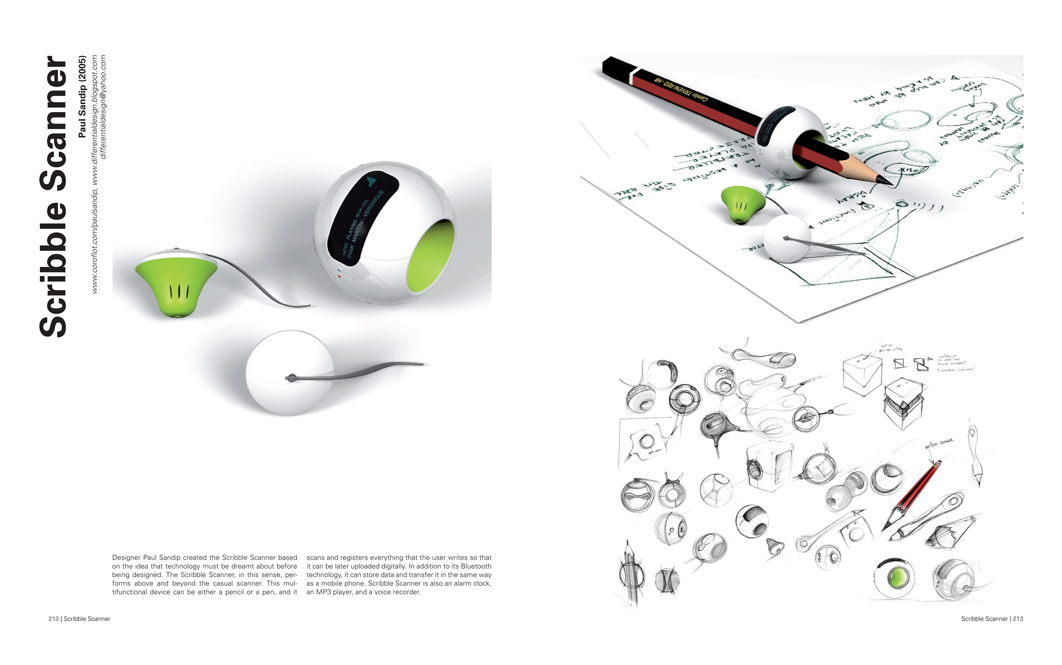
Product : Ate - Pencil Eater

Designs of the times - Hindustan Times

15.11.08

Think about the Box.


::vertical thinking::
Technical Skill is the mastery of complexity...and one of the major tools for technical innovation is vertical thinkability.
Vertical thinking helps one to analyze complex situations and is headed towards looking for the right approach.
It is sequential in nature and one must be correct at every step to reach the desired destination.
Please take note of the phrase –“ desired destination”.
One of the major drawbacks of such kind of thinking is that one always opts for the “right” solution and subsequently settles for an adequate solution rather than exploring a better solution.
::lateral thinking::
Lateral thinking is much about creativity.
Rightly said, lateral thinking is like a reverse gear in a car. When caught in a blind alley it helps one to find a way out.
However, one amongst several drawbacks is that it is an aimless journey in search of a “desired destination”.
::differential thinking::
our basic education teaches us vertical thinking… our design education teaches us lateral thinking...the industry teaches us differential thinking!
I believe it is the most effective form of mental activity which if practiced, helps one reach the “desired destination”…on time.

21.6.08

Who ate my pencil?


Peeling down to the heart of the existing sharpeners helped me reveal the essence of its basic working principal - the wrapped cone with a blade mounted onto the inner end, acting as a chiseling edge for the pencil inserted in it. Thus, creating a comprehensible and delightful product.

8 (Ate) is a double – bladed Stainless Steel pencil sharpener which effectively sharpens large and small pencils to a comfortable sharp tip every time.

ATE is all about voluntary simplicity. It is about unifying form and function.

The design of ATE points towards two notions. One is the idea that the simplicity of the product form will bring a cheerful feeling to people, and the other is the lowering of the production cost. Both are achieved mainly by simplifying the construction of the sharpener.

1.5 inch in size, ATE has no moving parts. One inserts the pencil into one of the holes, and twists the pencil while holding the sharpener motionless. The inbuilt blade shaves the wood of the pencil, thus sharpening the tip. ATE also answers the problem of sharp tips getting broken in the event of sharpening the pencils, as the sharp tip never touches any part of the sharpener. The dual cone caters to both traditional and thick chubby pencils.

ATE, when rolled over, moves in a circular fashion due to its uneven cone size. This is quite an interesting sight on the table top!


SPOOn feeding


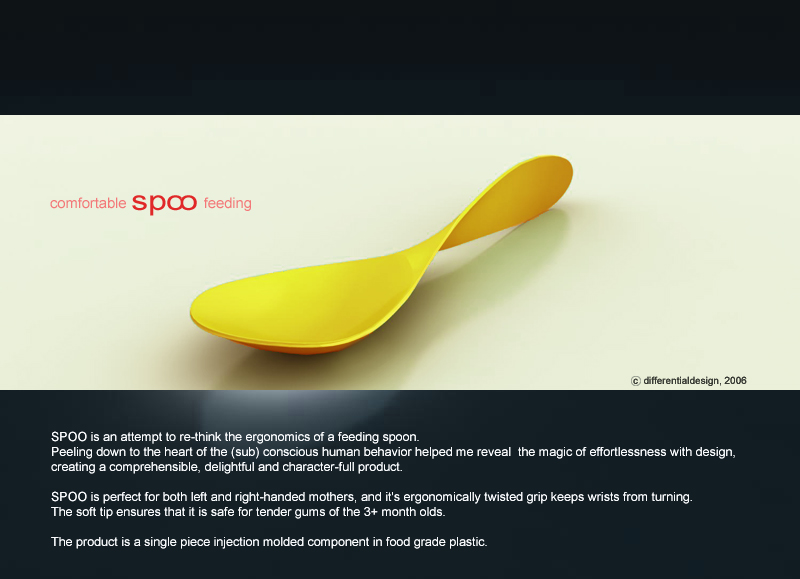
SPOO is an attempt to re-think the ergonomics of a feeding spoon.
Peeling down to the heart of the (sub) conscious human behavior helped me
reveal the magic of effortlessness with design, creating a comprehensible, delightful and character-full product.

SPOO is perfect for both left and right-handed mothers, and it's ergonomically twisted grip keeps wrists from turning.
The soft tip ensures that it is safe for tender gums of the 3+ month olds.

It is an innovation for modern parents!

Unifying form and function

"A beautiful body is as important as a beautiful mind." -self

Bathroom slippers that allow water to flow below them...and so you don't slip on wet tiles!

Ridges both on top and bottom surface...for your feet and floor!

Nature has been always a source of inspiration for me.

It took me two years to unify Form and Function!


16.6.08

The Mug Story...


Disposable Mug

It all started at the railway compartment.
This might have been the umpteenth time I was traveling with a wait-listed ticket. Well that’s quite a common sight in this part of the sub-continent.

Indian Railways is the second largest network in the world and every day millions of passengers travel by its trains; with 27% of them being long distance travelers and it has been doing a spectacular job notwithstanding the various kinds of pressures and obstacles it faces. But one area which needs significant improvement is the lavatory.
People use all sorts of materials in the lavatory, e.g., plastic mug, plastic tea/coffee cups, empty mineral water bottles, plastic glass or toilet paper. Given a choice, most of the passengers would prefer products which are portable, disposable and eco-friendly to be used in the lavatory. Indians prefer water to toilet paper.

Indian Railways can maintain the hygiene of the lavatory in a major way by introduction of this disposable mug made of paper. Presently The Indian Railways does not provide anything in the lavatories except water to wash after defecating.

I was informed and inspired by people's behavior and experience — physical, cognitive, social, emotional, and cultural.

Hygiene and ergonomic issues (both physical and cognitive) were my major focus areas.
User survey pointed out that a handle is a must in a mug and that the user’s hand should not touch the toilet floor in any case.
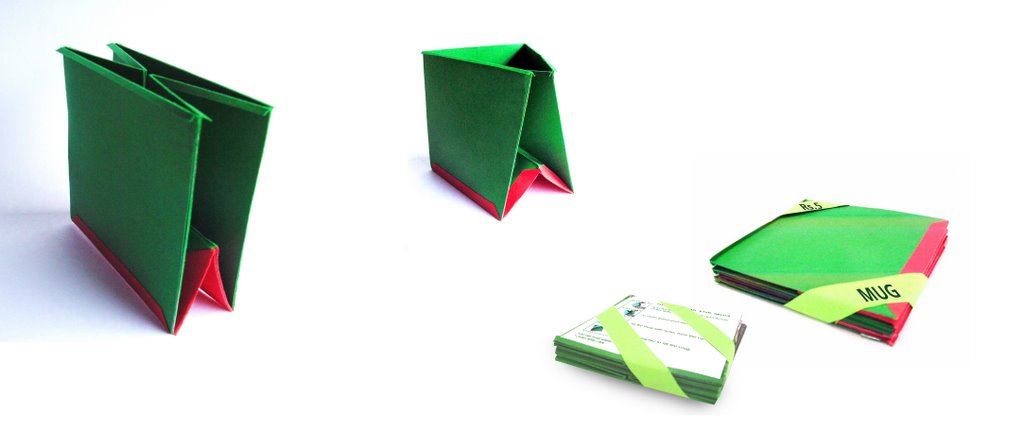
Finally I came up with a folding mug which is made out of a single sheet of paper by a technique called surface development with an inbuilt handle.
I thought of different material options and finalized on hand made paper so that the mug disintegrates after some time to avoid its reuse.

Aesthetic appeal and ease of use :

Cube: one of the basic forms has always fascinated me.
This product of mine shows a gradual transformation between two basic end shapes; a square and a triangle, held within a cubical space.
The gradual transformation also gives the mug its inbuilt handle.
The square base allows the mug to rest in equilibrium and the triangular rim gives the mug its double snout.
The double snout makes the mugs usage easier for both the left and the right handed.

Materials used :

The mug is made up of hand made paper (the grade of paper cannot be disclosed due to IPR issues)
No synthetic adhesive has been used to make it completely eco-friendly. Instead, organic glue has been used.
Advantage over similar products and why it is superior :

No such product exists presently in the market.
The mug I have designed is meant for washing after defecation in lavatories in the train compartments. It can hold about 1.2 litres of water, which is quite an amount of water to fulfill the task.
Presently people find out affordance of other utility products available during journey
(mineral water bottles, tea/coffee cups etc. which are primarily made from plastic) and slightly modify it to use. Disposal of such products create a nuisance in and around the train as well as the railway tracks.
However, my mug disintegrates within about 15 minutes after use.
The mug is foldable and occupies insignificant space of ones luggage.
It easily fits into ones pocket!

Scope for commercial production :

The mug is very easy to manufacture.
One time investment in the mould is required.
After the paper is cut to size it has to be folded and then 4 edges have to be glued.
I have also designed its packaging.
It will be sold in a pack of three for rupees five.

The mug has been selected from over 100 entries all over the country in a national talent search conducted by National Design Business Incubator in 2003.
It has been vetted by an eminent panel comprising NID and IIM faculty in areas of Product Design and Operations respectively.

I am expecting my design registration no. anytime next month. The design application no. is 194452 dated : 06/02/04
I will be applying for a commercial patent very soon.

I have also given a presentation to Mr. R.S. Virdi, EDME (Chg.) Railway Board and finally got his approval on supplying 3 mugs per passenger in the A/C coaches on a trial run for 3 months on trains ex-Ahmedabad. The railway will be distributing these mugs free of cost along with the linen, in A/C coaches.

The Indian consumers are price sensitive and prefer to buy value for money products.
The environmental awareness in India has started affecting marketing of products based upon their eco-friendliness. In general, Indian consumers are likely to buy environmentally responsible products and packs. The future key for marketing could be to select more ethical and ecological responsible products and packaging, which is also convenient for consumers, thus, balancing environmental concerns with commercial considerations.

Winner of Business World Design Excellence Award 2004, “Best Indian Concept”.

Clotheline Clip


*design registration pending.

check this :http://www.treehugger.com/files/2006/09/sandip_pauls_cl.php

14.6.08

Redifining the Ubiquitous

(Vol-3 No-6 Newsletter of Design For All Institute of India, June 2008)
..............................................................................................................................


For quite sometime now I have been deeply intrigued by the everyday mundane objects lying all around us. The market is flooded with a plethora of redesigned products but very few redefined objects.
When one re-designs a product, one tends to retain the essence of it’s being…the soul.
However gives its body a complete make over…without even hitting on the mind.
When we re-define, as the word itself suggests, we work on the soul of the product, we question its very existence. Thus, giving the product a new mind and a fresh body.
Body attracts!
A beautiful body is as important as a beautiful mind.
An aesthetically balanced product drives the customer close to itself. “Form-material” relation is one of the demanding parameters of a good-looking product. It makes it desirable.
Color adds the oomph factor!
Mind is that aspect of the product, which interacts with the user/customer.
Sometime it directs the user to handle the product in a particular way and sometime it doesn’t.
(context: democratic design!)
Soul is the essence of its being, its purpose, satisfying the user’s wants/needs.
It brings about the WOW! Factor. A good product is which is a perfect balance of BODY – MIND - SOUL.
Everyday products, they are so numerous and ubiquitous as to be frequently taken for granted. Yet they form the material framework of our existence, enabling it to function, not only in practical or utilitarian terms, but also in ways that give pleasure, meaning and significance to our lives.
I believe in voluntary simplicity. It is about freedom. It is about wanting less. It permits one to spend less time on innovating features (which land up adding clutter) and more time bringing in new experiences, insights, and relationships between the product and the user. It is rather difficult to say much about my approach towards design, but I have a fascination for monolithic, mono-colored ‘organo-mathematic’ forms and whatever needs I have felt and observed I have tried to translate them into products.
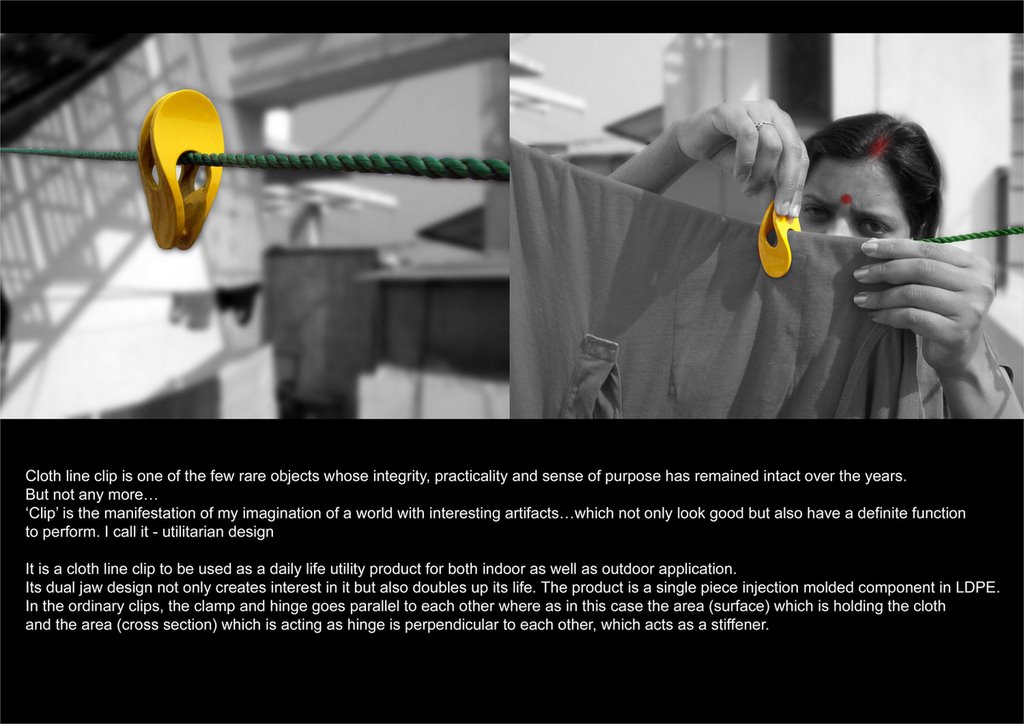
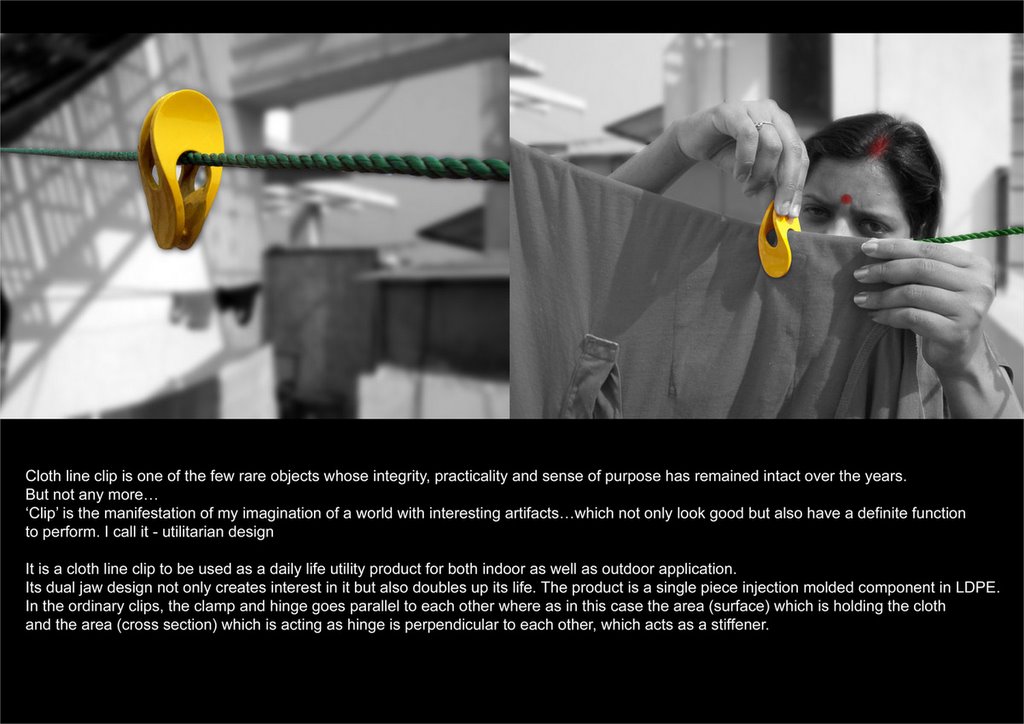
Redefining something as ubiquitous as the clothes line clip was a risky thing. It is one of the few rare objects whose integrity, practicality and sense of purpose has remained intact over the years. Although various shapes and materials have been explored, none have an emerging brilliance of a perfect match of form and function.
‘Clip’ is the manifestation of my imagination of a world with interesting artifacts…which not only look good but also have a definite function to perform.
I call it - utilitarian design.
To whatever modern life style we adapt to…the need for clothes peg would still be there…especially in India. But as we are moving toward more and more eco-concerned social structure…the need to think of green design has taken the front seat. The basic aim of my design was to create a single piece product with recycled plastic with no metal components.
:Integrity of purpose:
It is a cloth line clip to be used as a daily life utility product for both indoor as well as outdoor application. Clip fulfills more than it promises – not only in use, but the perceived pleasure is far than expected.
:Technical Uniqueness:
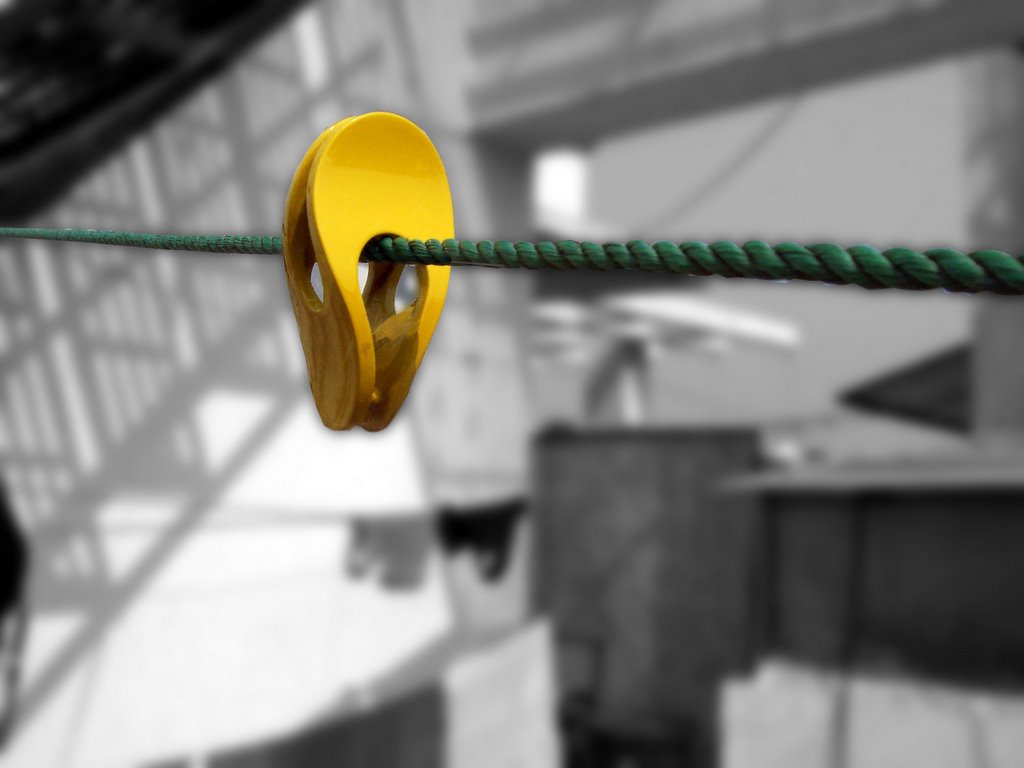
The product is a single piece injection molded component in recycled plastic with reduced number of components. Its primary innovation is the possibility of being hanged by both of its extremities. Hence, the user does not need to check the jaw side every time he/she is hanging the laundry. Moreover, one needs to only slide this clip over the cloth, hung on the line, and does not require applying any pressure. The geometry of the Clip + the flexibility of the material (LDPE) allow it to do so. This attribute is of great help to the aged / arthritic people.
The fundamental configuration of the common cloth line clip has been altered in this design.
In the ordinary clips, the clamp and hinge goes parallel to each other where as in this case the area (surface) which is holding the cloth and the area (cross section) which is acting as hinge is perpendicular to each other, which acts as a stiffener.
It leaves no rust marks on clothes, as there is no metal component.
:Advantage by design:
How does it stay in one place and not slide along the washing line?
It is intended that they slide over the garment and cloth line, rather than open and close spring-like as most clips do.
Regular clips cling tightly onto the cloth as well as the line. Hence they are always under stress-strain situation. However, the Clip, which I have designed, rests in equilibrium once it has been slid onto the line. Hence more stable and more durable, apart from having a dual jaw which increases its life two folds.
During any heavy wind flow, a regular clip will try to come to equilibrium and hence may jump out of the line. But my clip will smoothly slide over, but will never leave the line.
Clip is simple, no moving parts, suited to less dexterous fingers and made from recycled plastic.
:Longevity (USP):
Indian customer has an irresistible propensity towards stretching the usage of any product more than its expected life.
The dual jaw design of this clip not only creates interest in it but also doubles up its life.
If one jaw is damaged, the other jaw still remains functional.
:Fair cost-fair price:
Less priced than the existing clips. Due to reduced number of components and subsequently lesser number of operations involved in production process.
:Commercial viability:
‘Clip’ is a desirable, useful and long lasting everyday object. It has the potential of being locally manufactured, hence being available to every household!
CLIP is the winner of Organic Award 2007, San Francisco, CA


Bad Design


It so happened, that i were to take a print...about 5500mm by length...(thats quite long!)..from the plotter at my office. The paper roll was almost exhausted...but wasn't completely empty though.
I had no clue if the amount of paper left in the roll would suffice my requirement or not!(Bad Design)
Thats when i thought of this simple yet effective solution.
Since the dia. of the spindle in known..and also the thickness of the paper...so if there is a calliberation on the wheel of the spindle...then we might be able to atleat get an approx. idea of the amount of paper remaining in the roll!

[ Love - o - Meter ]


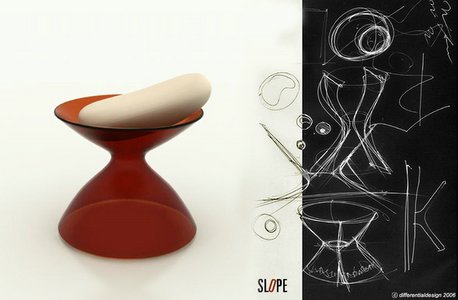
SLOPE - soap dish

This dish keeps your soap "high and dry" when not in use. With its funnel shaped bowl and sinuous stem, water is drained away by surface adhesion. Posted by Picasa

13.6.08

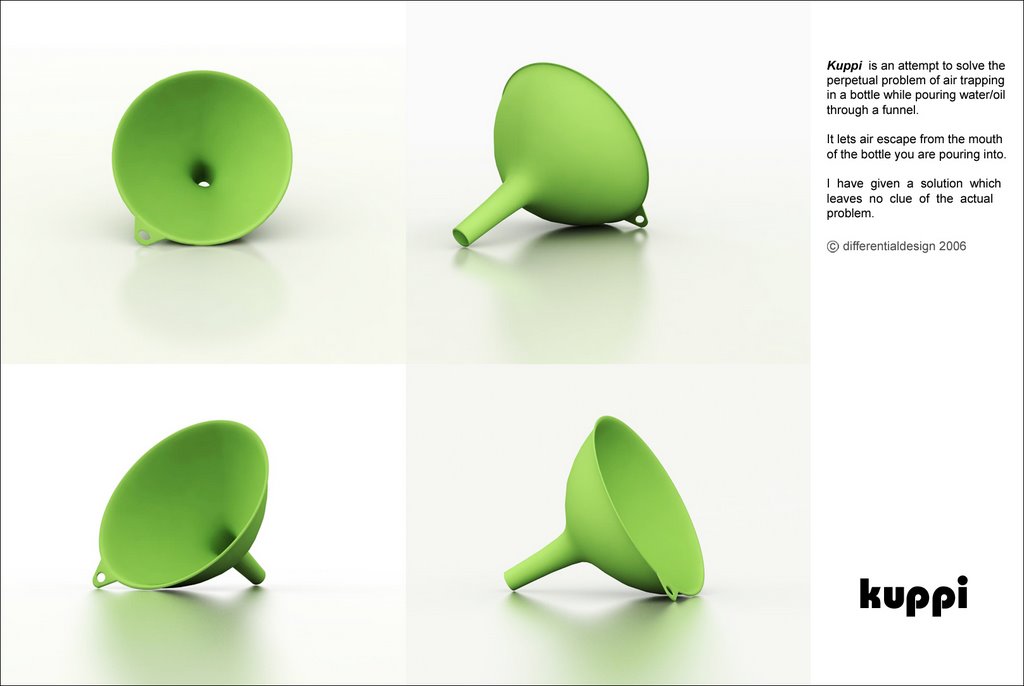
Kuppi


Design point : The top and bottom section is circular....but the neck is eliptical!